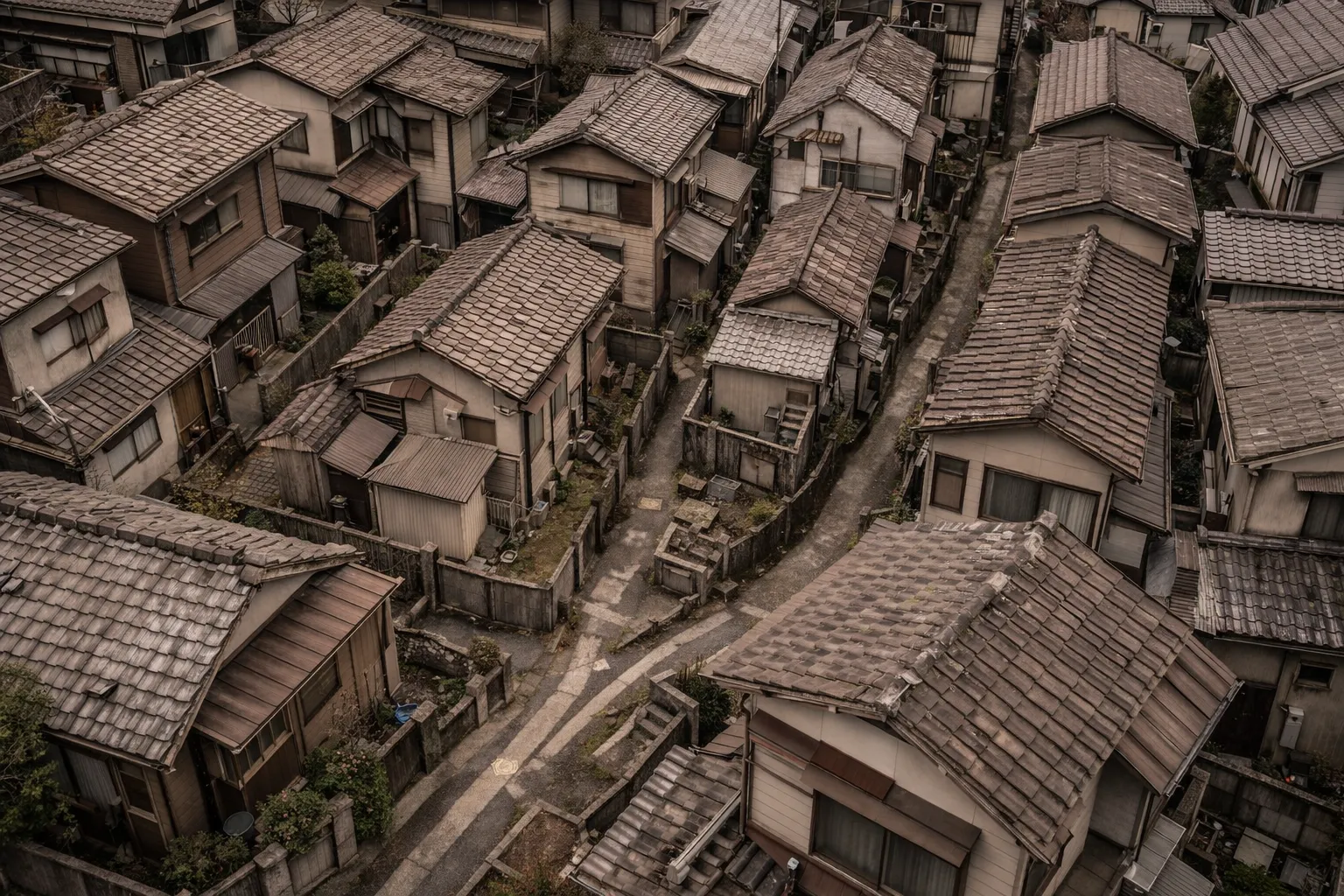
"One House, Five Land Parcels" — Deciphering 9 Registry Records from a Showa-Era Subdivision
Introduction — I Couldn’t Believe What I Saw in the Registry
I received a brokerage request for a subdivision home. A relatively new detached house, within walking distance of the station, priced at market value. It looked like a perfectly normal property.
Until I pulled the land registry records.
The lot was divided into five parcels. Two main residential parcels, with three narrow strips sandwiched between them. Their areas were 5㎡, 6㎡, and 18㎡ — more like pathways barely wide enough for one person than residential land. On top of that, the frontage private road was split into four additional parcels, each owned by a different household.
At first I thought, “Is this some kind of spite?” Then I suspected intentional subdivision for tax optimization. But as I carefully read through all nine registry records, an entirely different story emerged.
This is a record of the “time bomb” that a Showa-era (1970s–80s) subdivision created over half a century.
Chapter 1: It Was Once a Single Large Plot
It all began in 1978. In a residential area on the outskirts of Tokyo, there was one large plot of land.
The landowner sold it to a subdivision developer, who immediately divided it into over a dozen parcels — residential lots, passageways, and private roads. This was the standard development pattern of the era.
The design philosophy was as follows:
- Main residential lots for each household (approximately 60–130㎡)
- Shared passageways connecting adjacent houses (narrow strips of 5–18㎡, co-owned 50/50 by two neighboring households)
- Private road parcels (approximately 18㎡ each, with each household in the subdivision owning one parcel)
It was a rational design for its time. Two households could cooperate to maintain the shared passageway. If each household owned one road parcel, no one could refuse passage. It was the Showa-era developer’s form of practical wisdom.
The problem was that this design never anticipated the world 50 years later.
Chapter 2: Two Families, Five Parcels
Let’s return to the property in question.
In 1983, the Nakamura family (pseudonym) purchased a section of the subdivision. They solely owned the main 67㎡ residential lot and built their home on it. They also acquired a 1/2 share in the three shared passageway parcels (totaling 30㎡).
Two years later in 1985, the Fujita family (pseudonym) purchased the adjacent lot — a 66㎡ residential parcel plus the remaining 1/2 share in the same three passageway parcels. The Fujita family purchased under joint ownership of three people (shares of 90:30:21), likely pooling funds among relatives.
So far, nothing unusual. Two houses side by side, amicably sharing the passageway between them. A peaceful scene in a Showa-era residential neighborhood.
But from here, half a century of ownership complexity begins.
Chapter 3: Inheritance and Dispersal — Where Did the Owners Go?
The Fujita Family
In 1988, one of the co-owners died. The share was inherited by another co-owner, but the registration wasn’t completed until 2006 — 18 years after the death.
In 2024, another co-owner died. The share was inherited by a female relative. Only then were all five parcels finally consolidated into a two-person ownership structure.
The Nakamura Family
After purchasing in 1983, Mr. Nakamura relocated to central Tokyo in 1994. He kept the suburban house but changed only his registered address. In 1990, a credit guarantee company’s mortgage (¥4 million) was registered against the property, which wasn’t cleared until 2007.
The main lot remained solely owned by Nakamura; the passageways were split 50/50 between the Fujita and Nakamura families.
This situation persisted for nearly 40 years.
Chapter 4: Even More Staggering — The “Human Drama” of the Front Road
The real nightmare was in the front road.
Tracing just one of the four private road parcels (each approximately 18㎡) revealed the following events:
- 1981: Families A and B jointly purchased from the subdivision developer
- 1982: Different co-owners purchased another parcel; mortgage registered
- 1989: One co-owner divorced. Share transferred to ex-wife as part of property settlement
- 2004: Mr. A died; son inherited
- 2007: Son also died. His heir (wife) also died, resulting in absence of heirs
- 2010: Sold to a third party by a court-appointed estate administrator
- 2011: Resold. The buyer was a foreign national
- 2013: Another co-owner died; ex-wife consolidated shares through inheritance
A share of just 18㎡ of private road experienced 6 sales, 4 inheritances, 1 divorce settlement, and 1 case of absent heirs over half a century. Owners scattered from the suburban neighborhood to central Tokyo, to Chiba, and even overseas.
Chapter 5: The Developer’s Herculean Task of “Assembling” Parcels
In 2024, a residential developer decided to acquire a section of this subdivision, rebuild, and sell.
First, they needed to acquire all five lot parcels. They also had to secure private road shares.
Nakamura side: Had relocated to central Tokyo. Negotiation was possible if contact could be made, but there was a risk of reluctance to dispose of property left untouched for over 30 years.
Fujita side: Two of the three co-owners had died. Inheritance registration had been neglected for years; the sale couldn’t proceed until inheritance registration was completed.
Front road: One of the four parcels was acquired, but the remaining three were owned by residents of other houses or their heirs. For them, private road shares were land with “no reason to sell.”
The registry records show the developer executed the acquisition in this order:
- First, advance acquisition of one road parcel (purchased from two heirs)
- Completion of address change registration for the Fujita family
- Acquisition of all Nakamura shares, on the same day as all Fujita shares
Same-day settlement. They purchased from both the Nakamura and Fujita families simultaneously. Presumably, buying from only one side first carried the risk that “if the neighbor won’t sell, we can’t build.”
Chapter 6: Why Not Consolidate the Parcels?
The developer acquired all five parcels. Yet, according to the registry, they never consolidated them.
Several reasons are possible:
Cost: Consolidation may require boundary confirmation surveys, which take time and money. In the speed-oriented business model of residential development, selling without consolidation is more rational.
Relationship with the front road: The three passageway parcels may not meet consolidation requirements (same land category, same owner, no mortgages, contiguous, etc.) due to their position relative to adjacent land.
Practical judgment: As long as everything is accurately described in the important matters explanation document, there is no disadvantage to the buyer. Consolidation is “desirable if possible” but “not mandatory.”
As a result, a newly built house goes on the market in the seemingly unusual state of “sitting on five separate land parcels.”
Chapter 7: Lessons — When Dealing with Showa-Era Subdivisions
Here are the practical lessons from this property.
1. Obtain Registry Records for ALL Parcels
Don’t just get the main residential lot — obtain records for shared passageways, front roads, everything. In this case, 5 lot parcels + 4 road parcels = 9 registry records in total were needed.
2. Don’t Neglect Cross-Referencing Co-Ownership
In Showa-era subdivisions, the owner of the main lot and the co-owners of shared passageways may not match. Through inheritance, divorce, and resale, completely unrelated third parties may hold shares.
3. “Absence of Heirs” Is Not Someone Else’s Problem
As Japan’s population ages and birth rates decline, properties without heirs continue to increase. When this occurs with land that “no one actively manages” — like private road shares — the process must begin with court appointment of an estate administrator, which can take years.
4. Front Road Rights Are the Most Critical Item to Verify
Even if building code road frontage requirements are met, without secured road ownership or right of passage, there is a risk of future disputes. It’s essential to understand the entire private road structure of the subdivision and verify the owner of each parcel.
5. Unconsolidated Parcels ≠ Problems
It’s not unusual for developers to sell without consolidating parcels. What matters is understanding why they weren’t consolidated and being able to accurately explain this to the buyer.
Conclusion — The Registry Is a “Land’s Resume”
It took an entire day to decipher nine registry records. But within them was a human drama spanning half a century.
Sales, inheritance, divorce, relocation, absence of heirs, transfer to foreign nationals — land doesn’t move, but people do. And every time people move, another line is added to the registry.
Showa-era subdivisions exist in countless numbers across Japan. Many of them now face the same problems: aging owners, chains of inheritance, and increasingly complex co-ownership. Buildings may be rebuilt, but land rights remain frozen as they were half a century ago.
As real estate professionals, there is one thing we can do: read the registry. Go through it line by line, understand the land’s history, and accurately convey the risks to the buyer. That, I believe, is the only way to safely defuse the time bombs of the Showa era.
This article is based on a real property, with names, locations, and details altered. It is intended to raise awareness of practical considerations in real estate transactions.