
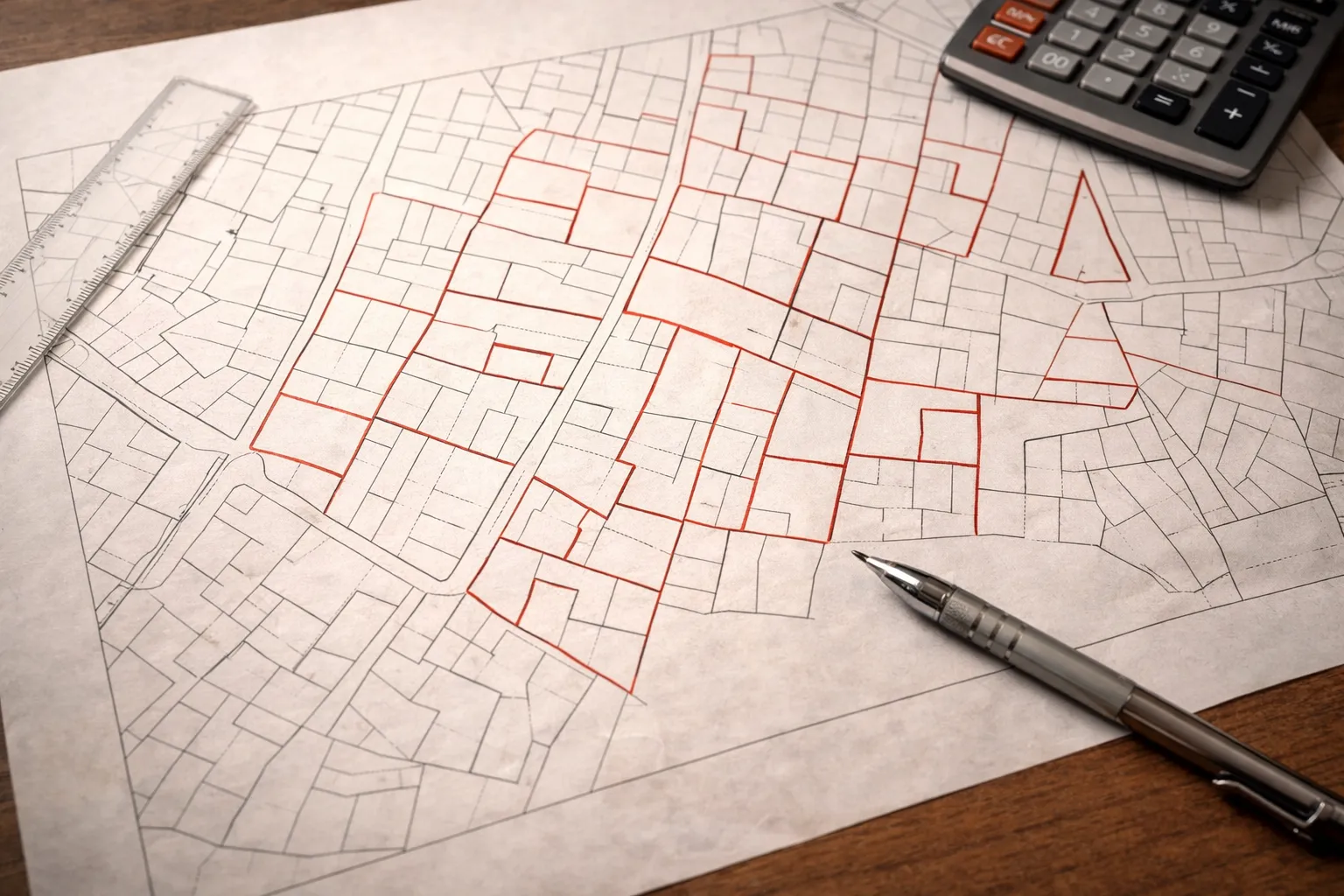
I Heard About "Aggressive Land Splitting to Reclaim Inheritance Tax" 10 Years Ago — Now as a Licensed Agent, I Put It to the Test
What You Will Learn
Q. What is an inheritance tax correction request (kōsei no seikyū)?
Q. Can land subdivision reduce inheritance tax?
Q. What is "unreasonable division" (fugōri bunkatsu)?
Prologue — Before I Entered the Real Estate Industry
It was around 2012. Back then, I was a systems engineer and knew nothing about real estate.
I heard secondhand about a tax accountant’s pitch:
“We redo inheritance tax filings to get refunds on overpaid taxes. Our fee is success-based. We use land subdivision to lower assessed values and recover anywhere from several hundred thousand to tens of millions of yen.”
I was skeptical. Could such a convenient arrangement really exist? Taxes are determined by law — shouldn’t anyone arrive at the same figure?
More than a decade later, I became a licensed real estate transaction specialist (takkenshi) and started running a brokerage. Through my daily routine of reading land registries, examining lot shapes, and checking assessed land values, the contours of that story gradually became clear.
This time, I decided to verify that old story from my perspective as a licensed agent.
Chapter 1: Was It Real? — The Inheritance Tax Refund Business
In short: it was real. And it was a bigger business than I had imagined.
According to National Tax Agency statistics, in fiscal year 2022 alone, a total of ¥1.41 billion was refunded to 673 heirs nationwide. That’s roughly ¥2.1 million per person on average, with high-end cases reaching tens of millions of yen.
Tax accountant firms specializing in inheritance tax actually exist to handle these refund procedures (called “requests for correction”). Their fee structure is entirely success-based — if the refund fails, there’s no charge.
Why does such a business model work?
The reason is simple: land valuation for inheritance tax varies significantly depending on the tax accountant.
Tax rates are fixed by law. But the preceding step — “how much is this land worth?” — depends heavily on the evaluator’s skill. Irregular shape adjustments, landlocked parcel adjustments, narrow frontage adjustments, excessive depth adjustments… miss an applicable deduction, and the assessed value inflates, increasing the tax. Moreover, even if you overpay, the tax office won’t tell you.
One tax firm’s website stated: “Among the landowners and property owners who consult us, roughly 70% have potential for inheritance tax refunds.”
Chapter 2: The Year 2012 — The Golden Age of Tax Optimization Schemes
Around 2012, when I first heard the story, inheritance tax schemes were flourishing.
The heyday of “large-scale land” valuation. For lots of 500㎡ or more in Japan’s three major metropolitan areas, assessment reductions of up to 65% were possible. The criteria were vague, and tax accountants routinely disagreed on applicability. This valuation method was abolished in 2018 due to its many problems.
Just after the correction request deadline was extended to 5 years. A December 2011 tax reform dramatically extended the deadline from 1 year to 5 years, instantly expanding the pool of eligible cases for the refund business.
The rush before the basic deduction cut. With the basic deduction set to be slashed by 40% starting in 2015, interest in inheritance tax planning surged.
The convergence of these three factors around 2012 marked the launch phase of the inheritance tax refund business. The number of refund claims surged 1.5x over the four years from 2012, exceeding 10,000 cases.
Chapter 3: The Reality of “Aggressive Subdivision” — Techniques to Lower Land Value
The core of the story I heard was “use subdivision to lower land valuation.” Now as a licensed agent, I can explain exactly how these techniques work.
Technique 1: Creating a Landlocked Parcel
Split one plot into two. Give the road-facing strip (the narrow part touching the road) to Heir A, and the large rear portion to Heir B.
Heir B’s land becomes a “landlocked parcel” with no road access. Since buildings cannot be erected on landlocked parcels, inheritance tax assessment allows a maximum 40% reduction. A ¥50 million assessment becomes ¥30 million.
Technique 2: Creating Irregular Shapes
Split the land diagonally to create triangles, or create extremely narrow strip parcels. Irregular shapes have low utility, enabling up to 40% reduction through shape correction factors.
Technique 3: Creating Narrow Frontage and Excessive Depth
Subdivide to create an extremely narrow road frontage, producing a long flag-shaped lot. Double application of narrow frontage and excessive depth correction factors aims for major reductions.
Combining these techniques, assessment values can theoretically be cut to less than half. At a 30% inheritance tax rate, that changes the tax bill by tens of millions of yen.
Even at a 30% success fee, the tax accountant earns millions. The client still keeps millions after the fee. It was a structure that benefited both parties.
Chapter 4: The Tax Authority Didn’t Stay Silent — The “Unreasonable Division” Barrier
However, as I dug into land registries and the Property Valuation Basic Circular as a licensed agent, I noticed this approach has a fatal weakness.
The National Tax Agency explicitly blocks these schemes using the concept of “unreasonable division.”
The note to Basic Circular 7-2(1) states:
When an estate division ignores actual usage conditions and results in unreasonable division — such that adjustments for landlocked parcels or shallow depth would apply, leading to assessments that don’t reflect reality — the pre-division lot shall be evaluated as a “single parcel of residential land.”
In other words, even after subdivision, the land is assessed as if it were never divided. The tax savings are zero.
The National Tax Agency’s website illustrates six specific patterns recognized as unreasonable division, complete with diagrams. Creation of landlocked parcels, strip parcels, and extremely small lots — it’s essentially a catalog of “aggressive subdivision.”
Tribunal Rulings Have Accumulated
In 2010, the National Tax Tribunal ruled that a case where post-division lots became landlocked and strip-shaped constituted unreasonable division.
Even more striking was a case challenging whether real estate transfers to a family-owned company made 18 to 20 years before the inheritance constituted unreasonable division. The deceased had sold only the road-facing portion to their family company during their lifetime, intending to have the remaining land assessed as a landlocked parcel at the time of inheritance. This too was ruled an unreasonable division.
If preparations made 20 years in advance don’t work, then “lifetime subdivision planning” isn’t safe either.
Chapter 5: Are There No Legal Subdivision Tax Savings?
Not all subdivisions are rejected. From a practitioner’s perspective, the following cases work legally.
Corner Lot Subdivision
Subdivide a corner lot (facing two roads) so different heirs take each parcel. If each post-division parcel can be effectively used as residential land, it’s not unreasonable division. For corner lots, the side-road influence addition only applies to one parcel, lowering the combined assessment.
Two-Frontage Lot Subdivision
Split a lot with roads on both front and back along road boundaries. This is also fine if each parcel remains usable.
The Standard: “Can Each Parcel Be Effectively Used After Division?”
What the tax authority examines is whether each post-division parcel can be effectively utilized now and in the future. If a building can be constructed, it can serve as a parking lot, or function as a garden — if you can provide a “rational explanation for use,” it doesn’t constitute unreasonable division.
Conversely, if you’re asked “What would you use this land for?” and can’t answer, the subdivision fails.
Chapter 6: A Licensed Agent’s View — The Fundamental Problem with Subdivision Schemes
As a licensed agent working in brokerage, there’s another fatal problem with these schemes beyond taxation:
Land marketability drops dramatically.
Creating a landlocked parcel intentionally might lower inheritance tax. But what happens when you try to sell? Almost no one buys land where buildings can’t be constructed. Even if a buyer is found, the sale price will be far below the inheritance tax assessment.
The same goes for strip parcels and extreme irregular shapes. Inheritance tax decreases, but the asset’s actual value is destroyed.
A property I recently handled was exactly this situation. A 1970s-era subdivision where residential land was split into five parcels, shared passageway interests were tangled in complexity, and the front private road was divided into four parcels with owners scattered across the country. It took the developer over a year just to sort out inheritance registrations before consolidating the site.
The rights complexity arose from different circumstances than tax planning, but I experienced firsthand the damage of “chopping land into small pieces.”
Epilogue — An Answer 10 Years in the Making
The story was true. And precisely because it was true, the National Tax Agency had put countermeasures firmly in place.
Around 2012, the gray zones were still wide. Unreasonable division rulings were few, large-scale land valuation was ambiguous, and the refund business was growing rapidly. Some of the schemes that tax accountant described may have actually worked at the time.
But more than a decade has passed. Large-scale land valuation was abolished, unreasonable division rulings have accumulated, and in 2022 the Supreme Court struck down even tower apartment tax optimization. The cat-and-mouse game between the tax authority and the wealthy continues, but the loophole of subdivision-based assessment reduction has been largely sealed.
What I learned as a licensed agent is the foolishness of destroying land value for the sake of tax savings.
Reducing inheritance tax by assessing ¥50 million land at ¥30 million means nothing if it only fetches ¥20 million when you actually try to sell it.
Land holds its greatest long-term asset value when it’s in a usable shape, with clear title, and is readily marketable. Destroying that through subdivision to save taxes today is, I now believe, like deliberately damaging your own assets.
→ Related article: Real Estate Fraud Targeting Parents with Dementia — The Enemy Is Both Outside and Inside covers how to protect a parent’s assets before inheritance happens — walking through family trusts, voluntary guardianship, and statutory guardianship from a licensed agent’s perspective. Before considering tax-driven subdivision, there are moves to make while parents still have capacity.
This article is based on the author’s personal experience and views and is not intended as tax advice. For specific inheritance tax consultations, please consult a licensed tax accountant.
This article is provided for general informational purposes only and does not constitute advice on any specific transaction or investment decision. For advice on your particular situation, please consult a qualified professional.