
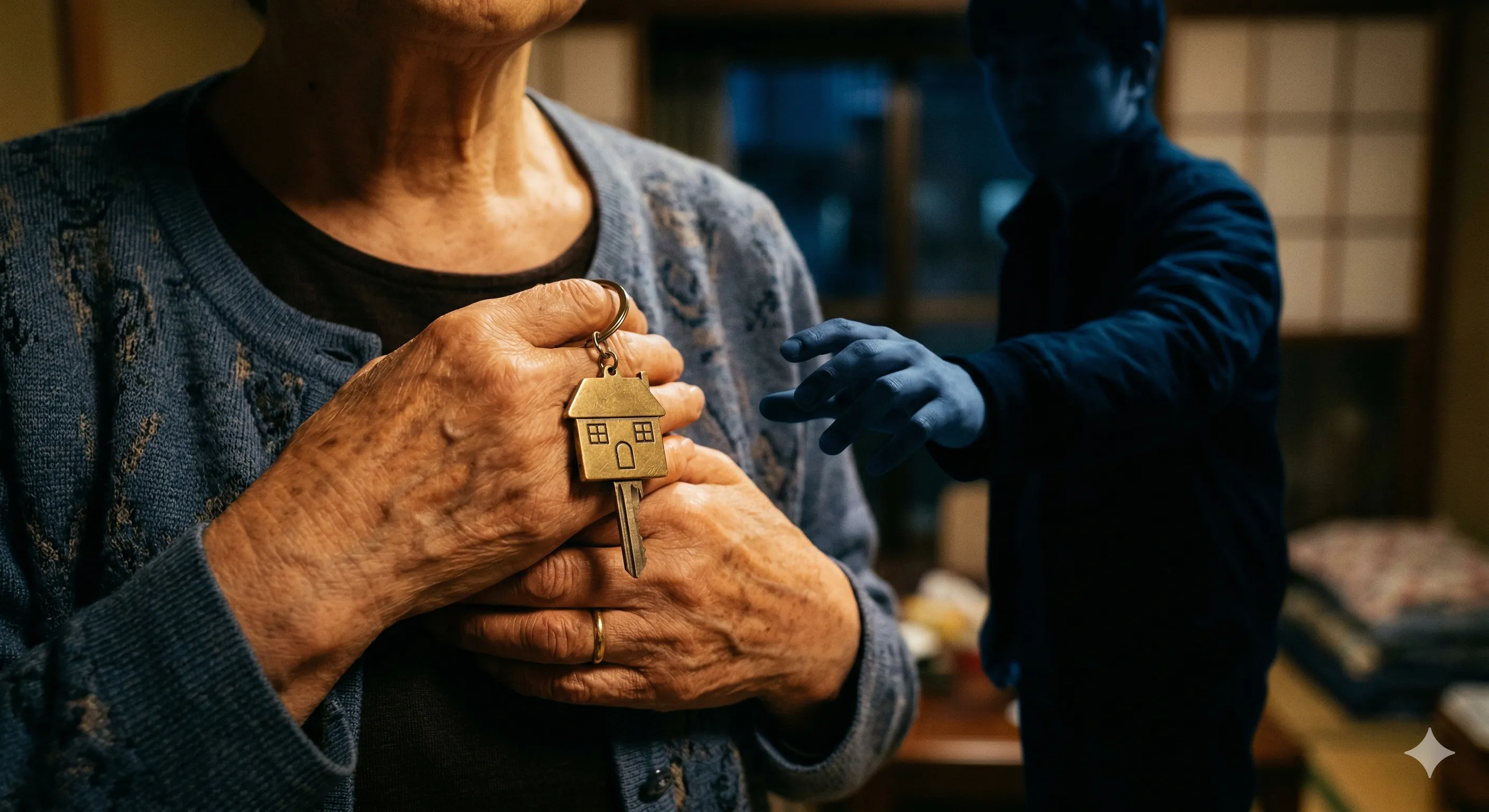
"Hand Over Your Assets" — How to Protect Your Wealth from Your Own Children
What You Will Learn
Q. Is it a crime for a child to demand their parent's assets?
Q. Can a family trust protect real estate from a child?
Q. Where can I seek help for elder financial abuse in Japan?
“Hand It Over”
An elderly man raised his voice over drinks.
His son, who had moved to the city, had come back home. The reason for his return was unclear. Maybe he quit his job. Maybe things did not work out. Either way, he had no money.
The first thing the son said when he arrived:
“You’ve got about ¥100 million in assets, right? Hand it over. I’ll invest it and support you.”
The father made no effort to hide his anger.
“An idiot like him would burn through ¥100 million in no time. Besides, my assets are real estate — not cash!”
The father’s anger was entirely justified. But this story should not end with “what a terrible son.”
Because this is happening all across Japan.
40% of Abusers Are Sons
Japan’s Ministry of Health, Labour and Welfare conducts an annual survey on elder abuse.
The results defy most people’s expectations. The most common perpetrators of elder abuse are not unknown scammers or nursing home staff.
It is sons. They account for approximately 39% — the single largest category.
Spouses follow at about 22%, and daughters at about 17%. Roughly 80% of elder abuse perpetrators are family members — this is the picture painted by the FY2023 MHLW Elder Abuse Survey (sources at end of article).
Among the types of abuse, financial abuse accounts for approximately 14–18% of all cases (the range reflects whether the data covers domestic caregivers or institutional staff). Pension siphoning, unauthorized savings withdrawals, wrongful disposition of real estate — all happening “within the family.”
The “hand it over” demand at the beginning of this article may actually be one of the less insidious examples. In most cases, financial abuse progresses quietly but relentlessly.
Common Patterns
Financial abuse follows several typical patterns.
Pattern 1: The Returning Child
A child whose career in the city has stalled returns to the family home and begins eyeing the parent’s assets. It starts with “just lend me a little” and escalates to “I’ll inherit it anyway, so it’s the same if you give it to me now.”
Pattern 2: Pension Management
“I’ll manage your bankbook for you, Dad.” It looks like filial piety. But cases where every pension deposit is withdrawn in full — leaving the elderly parent unable to cover basic living expenses — are reported to community support centers nationwide.
Pattern 3: Property Disposal Demands
“You should sell this house and convert it to cash.” Pressuring a parent to sell their home. Claiming the proceeds will be “invested” or “used for care costs” while actually funneling them into personal debts or entertainment.
Pattern 4: Exploitation During Dementia
As discussed in Protecting Parents with Dementia from Real Estate Fraud, children seizing control of a cognitively impaired parent’s assets is an ongoing problem. Once a child has the bankbook and seal, the parent has no means of resistance.
The “Relative Theft Exception” — A Legal Wall
There is a law you should know about: shinzoku sotou rei (the relative theft exception).
Penal Code Article 244, Paragraph 1 (formal title: “Special Provisions Regarding Crimes Among Relatives”) exempts from punishment theft, fraud, and embezzlement committed between spouses, lineal relatives, or cohabiting family members. For other relatives (e.g., non-cohabiting siblings), Paragraph 2 treats such crimes as offenses prosecutable only upon complaint — meaning prosecution is impossible without the victim’s formal complaint.
In other words, even if a son withdraws money from a parent’s account without permission, it is extremely difficult to impose criminal penalties.
“It’s a family matter” — that is what the law says.
Civil damages claims are possible, of course. But the hurdle for an elderly parent to file a lawsuit against their own child is extraordinarily high — both emotionally and financially.
That is precisely why preemptive defense, not after-the-fact remedy, is necessary.
Build a System That Makes It Impossible to Hand Over
The father at the beginning of this article pushed back against his son’s demand with anger. He could do so because his cognitive abilities are still intact.
But what about in five years? Ten years?
Dementia can happen to anyone. When you combine dementia with mild cognitive impairment (MCI, a pre-dementia stage), approximately one in four people over 65 is affected (MHLW estimate). Even if you can firmly refuse now, what happens if the same demand comes when your judgment has deteriorated?
What you need is not the willpower to say “no” — but a system that makes “yes” impossible.
Family Trust — The Best Tool for “Impossible”
If real estate is placed in a family trust, it cannot be sold or collateralized without the trustee’s approval. No matter how much a son insists “sell it,” the system makes it structurally impossible. For details on the family trust system, see Protecting Parents with Dementia from Real Estate Fraud. Here, I will focus only on the key points for parents.
The critical decision is who to choose as trustee. Appointing the son who is targeting the assets as trustee defeats the purpose. You need a trusted family member or a professional (lawyer, judicial scrivener).
Costs are approximately ¥500,000–1,000,000 when real estate is involved. Not cheap — but compared to the risk of losing everything, it is rational insurance.
That said, family trusts have limits. They provide no tax benefits, and losses on trust real estate cannot be offset against other income (a constraint of Japan’s Trust Act and Income Tax Act). They do not include personal care authority (medical decisions, hospital admissions), so this must be handled by combining with a voluntary guardianship contract. Most importantly, a family trust cannot be established once the parent has lost mental capacity. If you do not act while still in good health, the option disappears entirely.
Will — The Answer to “I’ll Inherit It Anyway”
“I’m going to inherit it anyway, so just give it to me now,” the son might say. But with a will in place, the parent decides who gets what.
A notarized will (kouseishousho yuigon) in particular eliminates risks of forgery or loss and carries strong legal force. By clearly specifying “this much goes to that son, the rest goes here,” you can minimize post-death disputes.
Comparing the Defensive Tools
The three tools cover different ground. Combining them is the standard approach.
| Tool | What it prevents | Cost guideline | When to start | Main limits |
|---|---|---|---|---|
| Family trust | Unauthorized sale or collateralization of real estate during life | ¥500,000–1,000,000 setup | While parent has capacity | No personal care authority; no tax loss offset |
| Voluntary guardianship | Personal care and asset management after capacity decline | ¥20,000–30,000/month (guardian fee) | Contract while healthy; takes effect after capacity decline | No investment-style asset management |
| Notarized will | Inheritance disputes; biased post-death distribution | ¥50,000–150,000 | While parent has capacity | Cannot prevent exploitation while alive |
Real estate protection during life: family trust. Post-death distribution: notarized will. Comprehensive care after capacity decline: voluntary guardianship. Understand each tool’s scope, then design the combination with a professional.
Do Not Decide with Emotion
“But my son is struggling…”
That feeling is understandable. As a parent, abandoning your child is difficult.
But think about it calmly.
If you hand over the real estate, will that son really “invest it and support you”? Is there no chance he will burn through the assets and come back asking for more?
The father at the beginning said it clearly: “An idiot like him would burn through ¥100 million in no time.” That instinct is probably correct.
Here is a story of what actually happened.
A man ran a high-end ryokan in a rural tourist destination. But the business only worked because of his father’s money and direction. When circumstances forced a sale, he walked away with ¥500 million.
He lost it all in six months.
Despite having no business experience, he bought a company and a factory. Working capital ran out almost immediately. He also handed money to a parade of people who approached him smelling opportunity. ¥500 million — gone in six months.
The man stopped working. He could no longer afford rent, and his children were sent to live with relatives. His wife worked full-time to cover living expenses and borrowed the shortfall from her siblings. When the man found out, he said without a shred of shame:
“Could you borrow some for me too?”
A nine-year-old child took over all household duties.
This is what happens when you hand assets to a person who should not be trusted with them.
Giving assets to someone who cannot manage money is not help. It can leave a far heavier burden on the entire family instead.
If you truly want to think about your child’s future, do not hand over assets. Protect the assets and build a system that provides support when needed, in the amounts needed. That is what family trusts, voluntary guardianship, and wills are for.
What You Can Do Starting Today
1. Secure Your Bankbooks and Seals
Do not hand your bankbook to your children. Do not share your PIN. This should be obvious, but many people share them casually because “we’re family.”
2. Check Your Property Registration
Verify that your real estate has not been used as collateral without your knowledge. Anyone can obtain a registration certificate from the Legal Affairs Bureau. Check at least once a year.
3. Consult a Professional
Family trusts and voluntary guardianship agreements cannot be set up alone. Consult a lawyer or judicial scrivener. It costs money, but far less than losing your assets.
4. Know Your Local Support Center
Your nearest Community Comprehensive Support Center handles financial abuse consultations. Under the Elder Abuse Prevention Act, municipalities are obligated to respond. You do not need to face this alone.
5. Feel No Guilt About Saying No
Refusing your child’s demands is not cold. Protecting your own retirement ultimately reduces the burden on your children. If you lose your assets, the cost of your care will eventually fall on them.
What Comes After “Not My Child”
Elder financial abuse continues to rise. Reported cases have hit record highs for three consecutive years.
“My child would never do that” — most parents think this. But statistics do not lie. 40% of perpetrators are sons.
This is not a story about troubled families. A child in financial distress reaching for a parent’s assets — that is a structural problem that can occur in any household.
Protecting your assets means protecting your retirement. And it means protecting your relationship with your children. Without money problems, the parent-child bond does not break.
Protect with systems, not emotion. That is the last — and most important — decision a parent can make.
Sources & References
- Ministry of Health, Labour and Welfare, “FY2023 Survey Results on Response Status under the Act on Prevention of Elder Abuse and Support for Elder Caregivers” (Japanese)
- Ministry of Health, Labour and Welfare, “Future Estimates of Elderly Persons with Dementia and Mild Cognitive Impairment (MCI)” (Japanese)
- Penal Code (Act No. 45 of 1907), Article 244 “Special Provisions Regarding Crimes Among Relatives” (searchable on e-Gov Law Search)
- Act on Prevention of Elder Abuse and Support for Elder Caregivers (Elder Abuse Prevention Act, Act No. 124 of 2005)
This article is based on observations and insights from the real estate brokerage field. The episodes herein are written with names, locations, and timing withheld to protect the privacy of the individuals and families involved. For individual legal consultations, please consult a lawyer or judicial scrivener. For real estate inquiries, please feel free to contact us via our contact form.
This article is provided for general informational purposes only and does not constitute advice on any specific transaction or investment decision. For advice on your particular situation, please consult a qualified professional.