Real Estate Fraud Targeting Parents with Dementia — The Enemy Is Both Outside and Inside
What You Will Learn
Q. What are the common patterns of real estate fraud targeting people with dementia?
Q. What is the difference between adult guardianship and a family trust in Japan?
Q. Can real estate be sold if the owner has dementia?
An Elderly Person Who Lost Everything
In 2026, an elderly person lost their entire savings in a transaction involving property shares in a 35-year-old condominium.
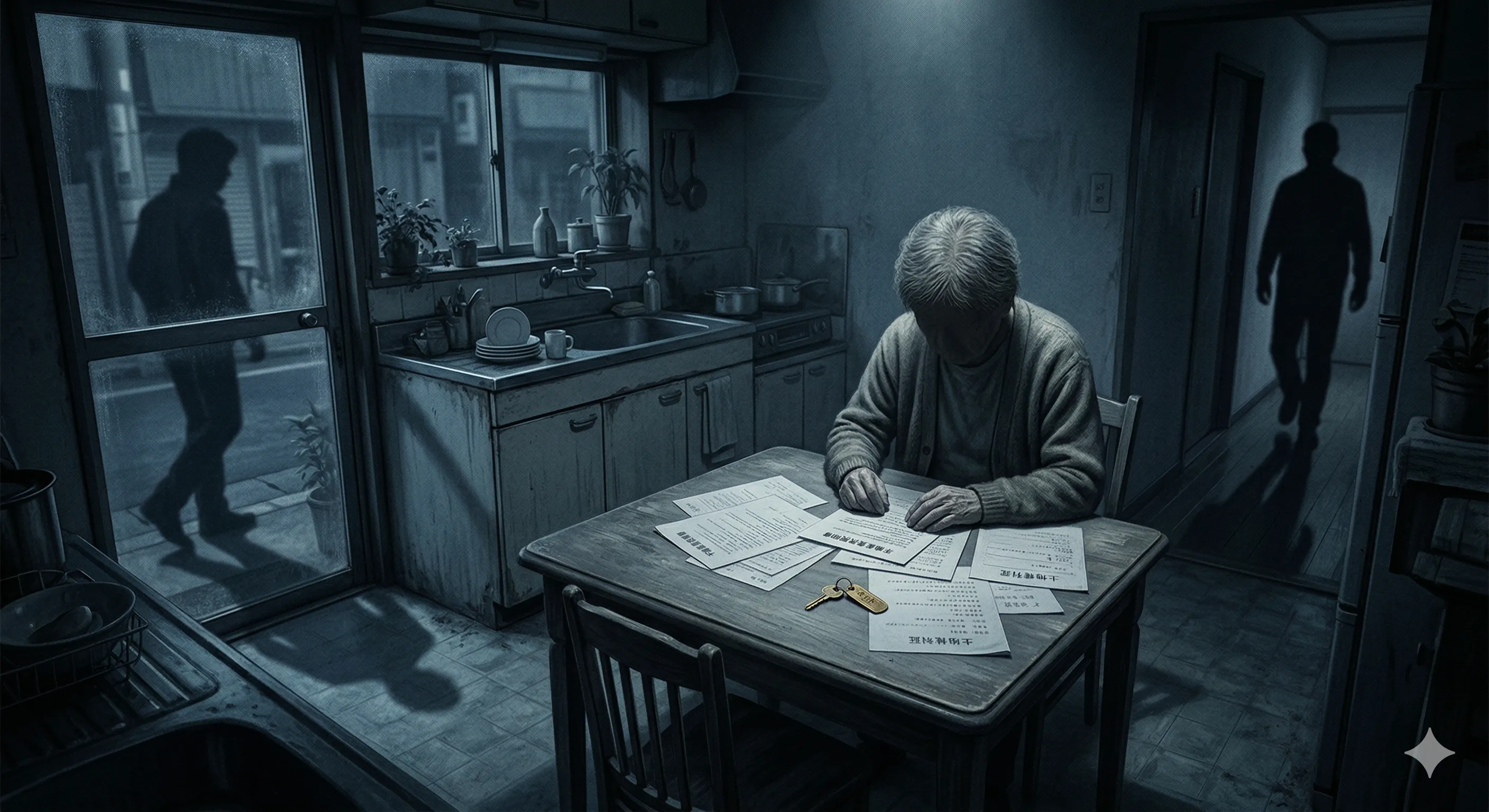
The scheme worked like this: approach an elderly person showing signs of dementia and have them sign a property share purchase agreement. The victim does not understand the contract. By the time anyone notices, their savings have been completely drained.
When this case was reported, many people probably thought, “The victim should have been more careful.” But telling someone with dementia to “be careful” is meaningless. They have dementia precisely because their judgment is impaired.
The real question is: who is supposed to protect them?
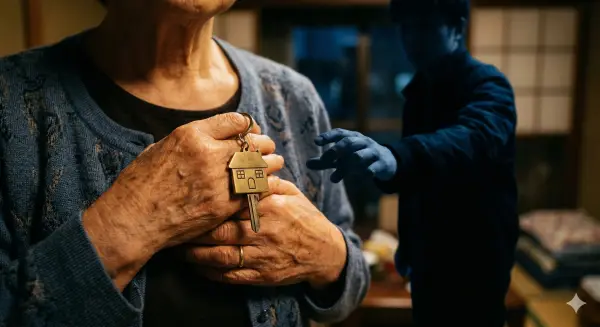
And there is another question. In this case, the “enemy” was an outside fraudster. But the enemy is not always on the outside.
When Family Becomes the Enemy
Here is another family’s story.
A man ran a high-end ryokan (traditional inn) in a rural tourist destination. The inn was built with his father’s money and under his father’s direction. The son had managed it for many years.
The problem was the man’s older brother.
The brother was a chronic spender. He repeatedly ran up debts and came crying to their father for money. As long as the father was healthy, the family managed to contain the situation.
But everything changed when the father developed dementia.
The brother, now out of money, pressured the younger brother to hand over the ryokan. The younger brother refused. Of course he did — he had spent years running the business.
So the brother manipulated their father with dementia into filing a lawsuit against his own son.
The details of the lawsuit are unknown. But the structure is clear: he manipulated a father who had lost his judgment, weaponizing the legal system to seize his brother’s assets.
The father died during the trial. When the younger brother returned to the family home, the older brother refused to let him in.
This was not a crime committed by an outside fraudster. It was exploitation from within the family.
Why Family Exploitation Is So Hard to Prevent
With outside fraud, there is room for third-party intervention. A bank teller might flag a suspicious transfer. In a real estate transaction, a licensed agent can check the seller’s mental capacity during the legally required disclosure process.
But with family, those safeguards do not apply.
Family members have daily access to the person’s living environment. They know bank account PINs. They know where the passbook and seal are stored. Above all, the victim trusts them because “they’re family.”
In the ryokan case, the brother positioned their father as the “plaintiff” in a lawsuit. Whether the father filed of his own will or was manipulated — legally, that distinction is extremely difficult to prove.
According to Japan’s Cabinet Office, approximately 40% of elder abuse perpetrators are sons. Including spouses, about 65% are cohabiting family members. The “enemy” who exploits the elderly is overwhelmingly likely to be a family member.
After Dementia Sets In, It Is Too Late
The property share fraud and the ryokan lawsuit share one thing in common.
Both happened after the victim developed dementia.
Once dementia sets in, the person cannot protect themselves. They cannot take legal measures either. An adult guardianship petition can be filed, but it takes time. A family trust cannot be established once capacity is lost.
In other words, protective action can only be taken while the parent is still competent.
Adult Guardianship — The Last Line of Defense
Adult guardianship (seinen koken seido) is a system that legally protects people with diminished capacity. A court-appointed guardian manages their assets and legal affairs on their behalf.
If guardianship had been in place, the guardian could have blocked the fraudulent contract in the first case. In the ryokan case, the guardian could have represented the father’s true interests and potentially prevented the unjust lawsuit.
However, the system has its limitations.
The court selects the guardian. Relatives can be candidates, but courts increasingly appoint professionals such as lawyers or judicial scriveners. About 80% of guardians are now professionals.
Guardian fees apply. Typically ¥20,000–60,000 per month — ¥240,000–720,000 per year. Over time, the cost adds up.
Once it starts, it continues until the person dies. Guardianship cannot be terminated simply because “it is no longer needed.”
Court approval is required to sell residential property. Even if the family needs to sell the home to fund nursing care, approval can take months.
It is not a perfect system. But it is incomparably better than having nothing at all.
Family Trust — Insurance While They Are Still Healthy
A family trust (kazoku shintaku) compensates for the weaknesses of adult guardianship.
A family trust is an arrangement where the principal (the parent) entrusts asset management to a trusted family member (the trustee) while they still have mental capacity.
For example, if a father places his home in trust with his eldest son, the son can sell the house and use the proceeds for nursing care even after the father develops dementia — without needing court approval.
Advantages of a family trust:
- Flexible design that reflects the principal’s wishes
- No court involvement required — faster action
- More flexible real estate management and sales than guardianship
- Can specify asset succession beyond the first generation
Points to note:
- Cannot be established after the principal loses capacity
- Setup costs include notarization fees and professional fees (typically ¥500,000–1,000,000 when real estate is involved)
- Poorly designed trust contracts can create unintended tax issues
- The trustee bears significant responsibility
Applied to the ryokan case: if the father had placed the ryokan’s management rights and assets in trust with the younger brother (who was actually running the business) while he was still healthy, the older brother could not have touched the property no matter how much he manipulated their father. Trusted assets are managed at the trustee’s discretion. No one can force unauthorized contracts in the name of a person with dementia.
What Adult Children Can Do Starting Today
“It won’t happen to us” — the people who think this are the most at risk. Neither the fraud victim nor the ryokan family ever expected to become involved.
Here are concrete actions you can start today.
1. Regularly Check Your Parent’s Cognitive Ability
Once a year is enough. When you visit, watch for these signs:
- Repeating the same stories multiple times
- Losing track of dates or days of the week
- Readily responding to calls from strangers
- Sloppy management of bankbooks and personal seals
- Accumulation of unnecessary contracts (newspapers, insurance, renovations, etc.)
2. Understand Your Parent’s Asset Situation
Know what exists and where.
- Real estate (home, investment properties, inherited land)
- List of bank accounts
- Insurance policies
- Debts and guarantees
- Securities
“It feels rude to ask about my parent’s assets” — that feeling is understandable. But if dementia progresses while you know nothing, there is no way to protect them.
3. Start Considering a Family Trust
Consult a specialist while your parent is still healthy. It costs money, but it is far more flexible than court-appointed guardianship after dementia, and long-term costs are often lower.
4. Set Up a Voluntary Guardianship Agreement
This can be used alongside a family trust. It is a contract made while the person still has capacity, specifying “if I develop dementia, I want this person to be my guardian.” Unlike statutory guardianship, the individual chooses their own guardian.
5. Calmly Observe Family Dynamics
Is any relative getting unusually close to your parent? Is any relative in financial difficulty? Is there unusual access to your parent’s bankbook or seal?
Suspecting family is never pleasant. But as the ryokan case shows, unguarded trust based on the assumption of good faith invites the worst outcomes.
”I Didn’t Know” Is Not a Defense
In an aging society, dementia can happen to anyone. As of 2025, approximately one in five people over 65 has dementia or is in a pre-dementia stage.
If your parent develops dementia with no preparations in place:
- Real estate cannot be sold (nursing care costs become out-of-pocket while waiting for guardian appointment)
- Bank accounts get frozen (banks restrict accounts once they learn of dementia)
- Assets can be stolen by malicious outsiders (the fraud case)
- Assets can be manipulated by family members (the ryokan case)
All of these can be prevented with advance preparation.
The law does not protect those who “didn’t know.” But for those who do know, there are real weapons available.
The only people who can protect aging parents are their adult children.
→ Related article: I Heard About “Aggressive Land Splitting to Reclaim Inheritance Tax” 10 Years Ago — Now as a Licensed Agent, I Put It to the Test examines inheritance-tax-driven land subdivision schemes from a licensed agent’s perspective. Alongside family trusts and voluntary guardianship, it is one of the asset-protection options worth considering while parents are still healthy.
This article is based on insights from the real estate brokerage field. For individual legal consultations, please consult a lawyer or judicial scrivener. Our real estate services handle complex transactions, including those involving elderly family members. For real estate inquiries, please feel free to contact us via our contact form.
This article is provided for general informational purposes only and does not constitute advice on any specific transaction or investment decision. For advice on your particular situation, please consult a qualified professional.