Nearly One Year Since China's Capital Controls — What Has Happened to Tokyo's Real Estate Market
What You Will Learn
Q. What are China's overseas remittance controls?
Q. How have China's remittance controls affected Tokyo's real estate market?
Q. Will Tokyo real estate prices fall?
Nearly One Year Later
The anomalies started around spring of last year.
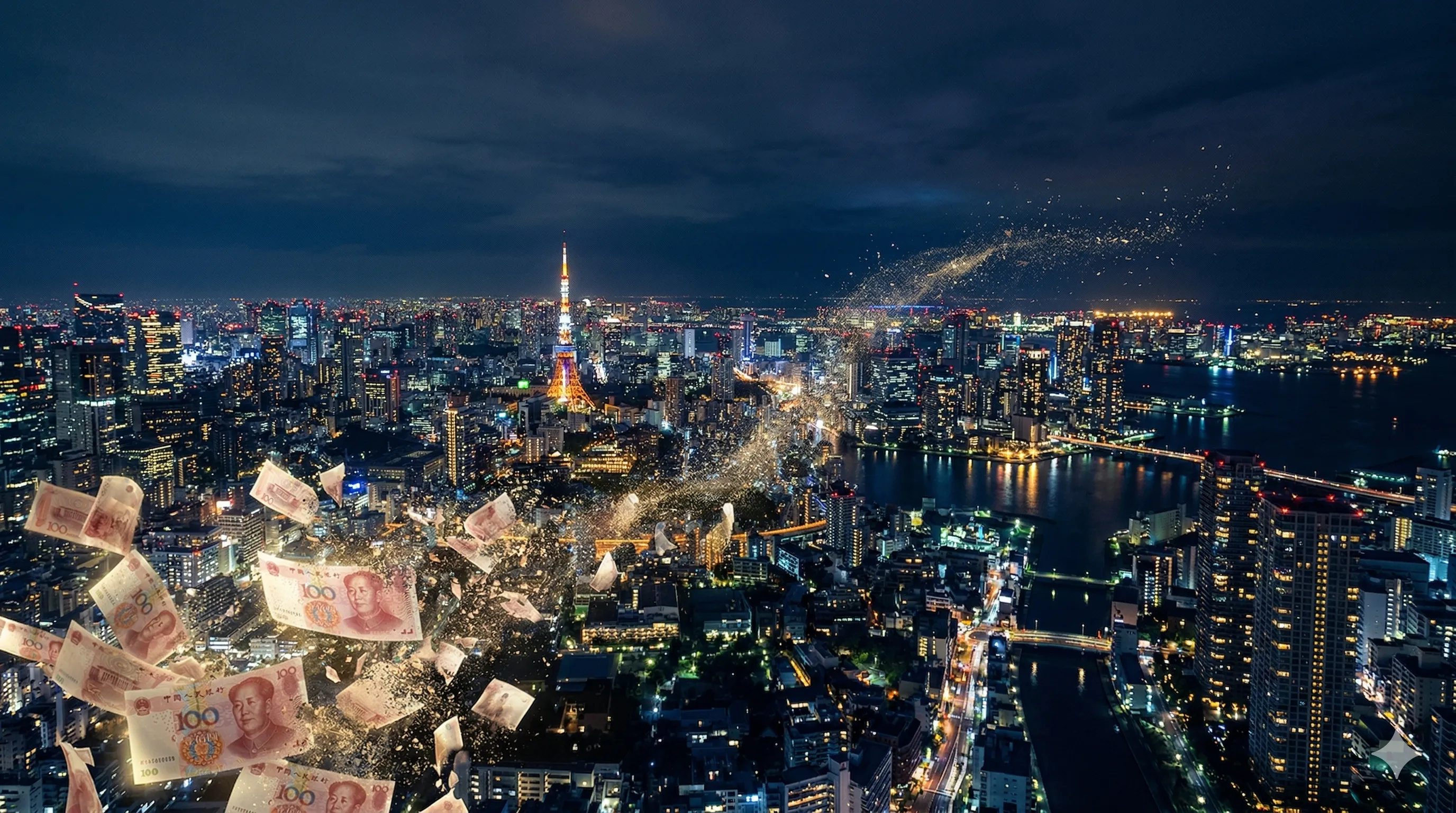
China tightened its grip on overseas remittances. Hong Kong fell under mainland-level restrictions.
The money stopped flowing.
Nearly a year has passed since then. At the time, I wrote on LinkedIn: “Something strange is happening this year.” The unease I felt then has spent twelve months becoming reality.
Looking back, the change was gradual. At first it was just “things seem a bit quieter.” But over six months, then a year, the market landscape visibly transformed.
What Happened
China has long imposed an annual $50,000 USD cap on individual overseas remittances. But until recently, workarounds were plentiful. Splitting transfers across family members’ accounts, underground banks, cryptocurrency, disguising capital flows as trade transactions — the wealthy found ways to move money out.
In 2025, those workarounds were shut down en masse.
The biggest shift was Hong Kong. It used to be China’s capital “exit door.” Move funds from the mainland to Hong Kong, then invest in Japan, Singapore, or Canada. That pipeline was placed under mainland-grade surveillance.
I heard that Hong Kong’s “Billionaire Nightclub” (大富豪夜總會) reopened briefly before being immediately shut down — apparently it was being used as a remittance loophole. The crackdown was that thorough.
What Has Happened to Tokyo’s Real Estate Market Over This Past Year
A year ago, these were “signs.” Now they are facts.
Chinese property viewings have vanished.
Weekends used to bring Chinese buyers with interpreters in tow, touring properties. Some would decide on the spot — “we’ll pay asking price.” They’re gone. Inquiries haven’t dropped to zero. But they don’t come to view. And when they do, they don’t commit.
Instant decisions have stopped.
Speed used to be the Chinese buyer’s greatest weapon. If they liked a property — same-day application, quick contract signing. Settlement typically comes a month or more later, and their funds were wired from overseas. That pipeline has been cut off. On top of that, the economic slowdown in mainland China is no small factor. They can’t remit even if they want to. Some can no longer afford to buy at all. This double pressure has completely halted the momentum.
Brokers are sitting on inventory.
This may be the most telling change of the past year.
Some brokers stockpiled properties popular with Chinese buyers — certain low-rise condominiums in central Tokyo and other types that Chinese purchasers favored — betting on resale. They built inventory on the assumption that “Chinese buyers will pay top prices.”
That assumption collapsed.
No buyers are coming. The properties they’re holding have become deadweight. In conversations between brokers, you hear things like “we bought X units.” Is it bragging? Complaining? Hard to tell. Either way, it’s not a statement made from a position of comfort.
Ultra-luxury properties are appearing on REINS.
Properties that should have sold quietly as off-market deals are now being listed on REINS — Japan’s broker-only real estate distribution system. In other words, they couldn’t sell behind closed doors. Sellers have no choice but to cast a wider net.
Off-market properties showing up on REINS. If you understand what that means, you understand how the market atmosphere has shifted.
The language around price cuts has changed.
Until last year, listings said “price revised” — a soft, euphemistic phrasing. This year, more and more simply say “price reduced.” Direct. No sugarcoating.
The shift in wording mirrors the shift in seller psychology. “Price revised” comes from a position of composure. “Price reduced” comes from urgency.
And the substance has changed too. Whole-building investments and tower condominiums are being marked down regardless of price bracket. Properties worth tens of millions of yen. Properties worth hundreds of millions. Sellers list at ambitious prices, wait months without a sale, then cut. The cycle is getting shorter.
That said, it’s the end of the fiscal year. Some price cuts are simply settlement-period tactics — clearing the books before the new year begins. Whether this wave of reductions is structural or seasonal won’t become clear until April.
Closing the Stable Door After the Horse Has Bolted
Last summer, the Japanese government began discussing “restrictions on foreign property acquisition” and a “vacancy tax.”
Too late.
Far too late.
Chinese capital began flowing seriously into Tokyo’s market around 2015. More than a decade later, with the flow already thinning, regulatory discussions finally started.
Closing the stable door after the horse has bolted. That’s exactly what this was.
And now, even that discussion has gone silent. With foreign buying appetite visibly declining, the perceived need for regulation has evaporated on its own. The irony is striking. When regulation was needed, no one acted. When it became unnecessary, they started deliberating. And then it quietly faded away.
The same thing happened after the bubble burst 40 years ago. Throughout the 1980s, as property prices climbed to absurd heights, voices called for curbing speculation. But the total volume restriction wasn’t implemented until 1990 — after the bubble had already peaked. Some argue the regulation itself triggered the crash.
Regulation always arrives late. Politics responds to voters who are hurting now, not to structural problems that might cause harm in five years. By the time countermeasures are enacted, the tide has already turned.
History repeats itself. Always a beat too late.
What Has Become Visible After Chinese Money Receded
A year ago, “what happens when Chinese money leaves” was speculation. Now, answers are emerging.
The overall market hasn’t collapsed.
Chinese money isn’t the only pillar supporting Tokyo’s property market. The weak yen attracts investors from around the world. Japan’s ultra-low interest rates persist. Inbound tourism keeps hotel and commercial property in demand. And Tokyo’s fundamental magnetism as a global city remains powerful.
But the divergence is now clear.
Segments where Chinese investors were concentrated — waterfront tower condominiums, downtown whole-building investments, certain ultra-luxury properties — are seeing corrections. More sellers, fewer buyers, falling prices. A textbook supply-demand adjustment.
Conversely, areas driven by domestic demand — suburban family homes, mid-range station-adjacent condominiums — have seen limited impact, just as expected.
Ultimately, “will Tokyo real estate go up or down?” is too crude a question. Which area, which price bracket, which type of property, and how is it moving? That’s what you need to watch.
From the Brokerage Floor
Honestly, the market is still moving.
Transactions happen. Inquiries come in. Everything hasn’t ground to a halt.
But compared to a year ago, the atmosphere has unmistakably changed.
For the ultra-luxury off-market properties our firm handles, the impact remains limited. Buyers at this level don’t rely on remittances from mainland China. They already have asset bases within Japan or have secured funding through other channels. The ultra-wealthy operate in a different dimension from ordinary capital controls.
But overall market sentiment has shifted. Real estate is partly a psychology business. As long as everyone believes “prices are still going up,” they keep rising. The moment doubt creeps in, the tide turns.
A year ago, I wrote “this may be a turning point.”
Now, that suspicion is becoming conviction.
Closing Thoughts — Lessons from History
Those who lived through the bubble collapse 40 years ago remember the atmosphere. “It’ll be fine.” “Tokyo is special.” “Land prices never fall.” Groundless optimism was everywhere.
A year ago, similar voices were audible. “The weak yen means foreigners will keep buying.” “Tokyo is the world’s most undervalued city.” “Prices still have room to rise.”
To be fair, conditions are different now. There’s no reckless overlending like the 1980s, and genuine demand underpins much of the market. I’m not sounding a bubble alarm.
But dismissing changes in the external environment is dangerous in any era.
Nearly one year since China’s remittance controls began. Whether this is a temporary disruption or the start of a structural shift remains unknown. Precisely because it’s unknown, we need to keep watching with clear eyes.
Real estate is an information business. Judge by numbers and facts, not emotions.
That’s what professional brokerage means.
→ Read next: The Executive Who Renounced His Hukou — What the Battle Between China’s Wealthy and Tax Authorities Means for Japan’s Property Market digs deeper into the power struggle behind these capital controls.
This article is based on observations from the real estate brokerage frontline. It does not constitute investment advice. For real estate inquiries, please reach out through our contact form.
This article is provided for general informational purposes only and does not constitute advice on any specific transaction or investment decision. For advice on your particular situation, please consult a qualified professional.